U.S. advertisers are projected to spend approximately $12.42 billion on affiliate marketing in 2025, an 11.3% year-over-year increase, while affiliate-driven sales generated an estimated $113 billion in U.S. ecommerce sales during 2024. Shopify's affiliate marketing statistics make the point clearly: getting paid for referrals isn't a fringe side hustle. It's a performance channel with serious money behind it.
The difficult part isn't finding a referral link. The difficult part is getting reliable credit for the introduction, protecting that credit from fraud, and recommending products without damaging trust. A large commission means little if a coupon site overwrites your attribution, a returned order cancels your payout, or your audience discovers that you hid the commercial relationship.
Table of Contents
Why People Get Paid for Referrals in the First Place
Businesses pay for referrals because a qualified introduction connects marketing spend to a measurable commercial outcome. A company can pay when someone purchases, submits a lead, starts a subscription, or completes another defined action, rather than paying only for impressions or broad exposure.
Affiliate marketing has grown from a small promotional tactic into a substantial acquisition market. U.S. affiliate spending rose from $5.4 billion in 2017 to a projected $8.95 billion in 2022, while global affiliate spending reached $8.6 billion in 2017, according to the affiliate marketing data compiled by Shopify. Companies have built systems to measure, validate, and pay for outcomes. That is the opportunity for referrers, provided they understand how those systems assign credit.
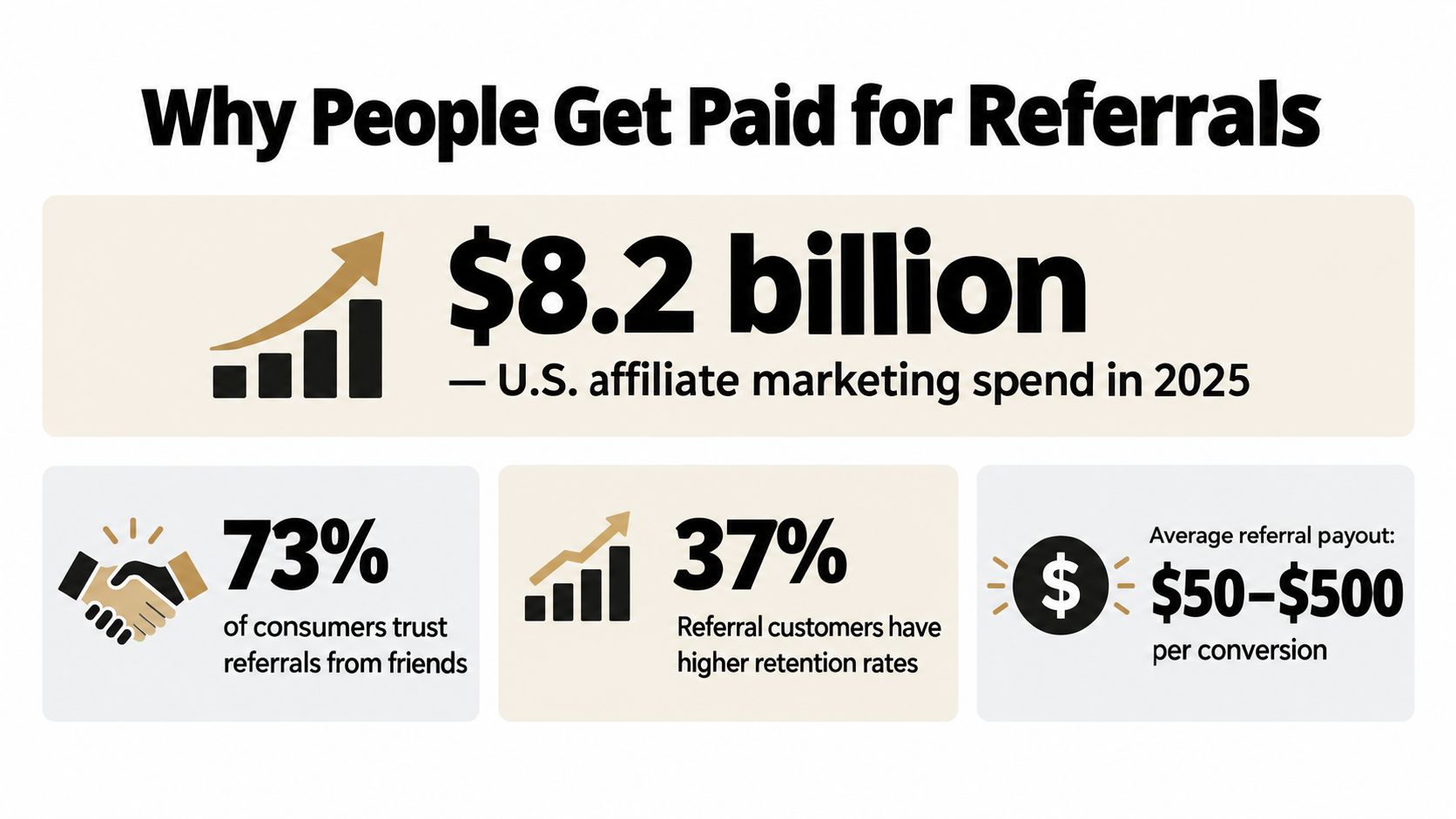
The economics behind a referral payout
A business usually pays for a referral for four reasons:
- Lower acquisition risk: The company pays after a defined result instead of paying only for visibility.
- Reach into trusted networks: A consultant, creator, customer, or operator can reach people a brand's ads may never persuade.
- Better context: A relevant recommendation can explain a product's fit, limitations, and use case before the buyer clicks.
- Scalable distribution: A company can work with many partners without hiring every partner as a salesperson.
Referral compensation aligns the partner's incentive with the company's commercial goal. The partner earns when an introduction creates value, while the company defines the action that qualifies for payment. That arrangement fails when terms are vague, attribution is fragile, or the program rewards volume instead of customer quality.
Central trade-off: Payment follows attribution, not effort.
Many beginners ask, “How much can I earn?” That question matters, but “What evidence proves I caused the conversion?” comes first. A referrer needs a traceable link, code, form submission, introduction record, or written confirmation. A program owner needs rules that identify legitimate referrals and reject duplicates, attribution fraud, and low-quality activity.
Weak disclosure creates a second failure point. A recommendation can convert and still damage trust if the commercial relationship stays hidden. Referrers should state clearly when a link or introduction may generate compensation, then explain the product, including relevant limitations. A high commission does not justify a vague recommendation.
Referrer and program owner are different jobs
A referrer promotes someone else's product or introduces a prospect. The role may belong to a newsletter operator, advisor, creator, customer, consultant, or founder with a relevant network.
A program owner creates the offer and pays partners. That owner sets the qualifying action, commission structure, attribution rules, approval process, payout timing, and dispute procedure. Confusing the roles leads to poor decisions. Someone seeking referral income must evaluate the program's evidence, terms, fraud controls, and payment history. A founder building a program must create rules partners can inspect and trust.
| Role |
What you do |
When you get paid |
Main risk |
| Referrer |
Introduce a prospect or promote a product |
After the qualifying action and approval |
Lost attribution, rejected conversions, delayed payment |
| Program owner |
Recruit partners and define the referral terms |
You don't receive a referral payout. You fund commissions after verified outcomes |
Fraud, poor-quality leads, compliance failures |
For founders, referral programs can support broader growth hacking strategies for startups, but the program should operate as a measured acquisition channel, not a decorative dashboard. For referrers, inspect tracking, approval rules, payment terms, fraud protections, and disclosure requirements before promoting anything. A headline commission rate means little when the program cannot prove or protect your earnings.
Four Program Types You Can Join or Run
Referral programs look similar from the outside, but their economics and obligations differ. The four structures below cover most opportunities a creator, consultant, customer, or founder will encounter.
| Program type |
Commission shape |
Typical payout threshold |
Best fit for |
| Traditional affiliate program |
Often a percentage of a sale or a fixed action-based bounty |
Set by the network or advertiser |
Content publishers, comparison sites, creators |
| SaaS partner program |
Recurring revenue share or a fixed bounty for a qualified account |
Often tied to an approved customer or billing event |
Consultants, agencies, operators, niche educators |
| Customer referral program |
Fixed credit, cash reward, or account benefit |
Usually triggered by a new customer's qualifying action |
Existing customers with genuine product experience |
| Professional introduction |
Fixed fee, percentage, or negotiated success payment |
Defined in an agreement after a completed transaction |
Advisors, brokers, consultants, and well-connected founders |
Traditional affiliate programs offer breadth, but they can bring more competition and more complicated attribution. A content publisher may earn from a tracked sale, yet the conversion can be affected by return rules, coupon codes, device changes, and last-click policies.
SaaS partner programs can suit professionals who influence software decisions. Recurring revenue share looks attractive, but it demands stronger record-keeping because the relationship may continue only while the customer remains active and the program terms remain unchanged. A fixed bounty is simpler to forecast.
Customer referral programs are usually easier for a solo founder or small newsletter to explain. The audience already understands the product through a customer story, and a fixed reward avoids asking readers to interpret a percentage of an unknown order value. The trade-off is that these programs may have narrower eligibility rules.
Professional introductions are the most relationship-driven option. A consultant may introduce a suitable company directly to a vendor and agree on payment if a transaction closes. This model can produce high-value outcomes, but written terms are essential. Define what counts as your introduction, how duplicate contacts are handled, when payment becomes due, and what happens if the deal closes after the relationship ends.
Pick the structure that matches your audience
A solo founder with a small newsletter usually shouldn't start with a broad network of low-commission software offers. The audience may respond better to one well-matched customer referral program with a clear action and understandable reward.
A specialist consultant with deep relationships may prefer direct introductions. A product educator with evergreen search content may prefer traditional affiliate links. A services firm that helps clients implement software may fit a SaaS partner model, provided it can disclose the relationship and support customers without overstating the product's capabilities.
A founder once joined a program because the commission percentage looked generous. The program allowed coupon publishers to receive last-click credit, and a coupon site overwrote the founder's referrals during checkout. The founder spent months generating interest but couldn't establish that the final conversions belonged to the original audience. The mistake wasn't a weak promotional strategy. It was joining before reading the attribution rules.
Choose the program whose tracking model, audience fit, and payout conditions you can explain in one conversation. If you can't explain when payment is earned, assume the program isn't ready for your audience.
Where to Find Legitimate Referral Opportunities
Start with products you already understand. A recommendation carries more weight when you can explain who benefits, who shouldn't buy, and what limitation might matter. Search established affiliate networks, SaaS partner directories, product launch communities, and the partner pages of brands you already use.
Direct outreach can work better than browsing a crowded marketplace. If you regularly advise founders on finance software, hiring systems, analytics, or customer support, contact the vendors that already solve problems your network has. Tell the company who you reach, what kind of introduction you can make, and how you expect to describe the product. A serious partner manager will explain the qualifying action and attribution rules.
Avoid lists that charge you merely to access referral opportunities. A legitimate program may require approval, identity verification, or tax documentation, but it shouldn't depend on selling you access to a vague collection of offers. If the business earns primarily from recruiting referrers rather than serving customers, walk away.
Screen every opportunity before sharing it
Use this shortlist before you publish a link or make an introduction:
- What is the attribution window? Find out how long the program credits a referral after the click or submission.
- Does last-click attribution apply? Ask whether another partner, coupon site, or paid ad can replace your credit.
- Which traffic sources are allowed? Check rules for email, paid search, social media, incentives, direct messages, and communities.
- How does payment arrive? Confirm the payment method, currency, approval cycle, and any required tax documentation.
- What is the minimum payout? A high balance that can't be withdrawn is not useful income.
- How do returns affect commissions? Look for refund holds, clawbacks, cancellations, and customer-quality reviews.
- How are disputes handled? Identify the support contact, evidence required, and deadline for challenging a rejected referral.
Read the affiliate agreement instead of relying on a promotional summary. Search for “attribution,” “duplicate,” “self-referral,” “coupon,” “refund,” “prohibited traffic,” “payment,” and “termination.” A founder can qualify a network quickly by answering those questions and rejecting any program that hides the answers.
Build a shortlist of a few relevant programs, then review it regularly. Your audience's needs change, products change their terms, and a previously reliable program may introduce new restrictions. Keep the list small enough to understand fully.
For opportunities relevant to founders and growth partners, review the IndieMerger affiliate opportunities alongside direct partner programs. Treat every listing as a lead for due diligence, not as proof that the economics suit your audience.
How SourceX Can Help
SourceX is designed for advisors, consultants, operators, and well-connected professionals who can introduce suitable companies to a business-data licensing process. The partner makes the introduction. SourceX handles qualification, rights review, pricing, contracting, data preparation, delivery, and payment.
A qualifying partner can earn 25% of the Actual Supplier Payout, excluding taxes and reimbursements, with rewards capped at $100,000 cumulatively per referred company. For illustration, a $400,000 supplier payout would produce a $100,000 referral reward, subject to program approval and terms.
SourceX works with companies that may license approved operational records, including support tickets, emails, documents, chat, and system records, for AI training and evaluation. The strongest introductions are knowledge-work companies with 50 or more full-time employees at peak, documented operating history, and substantial business records.
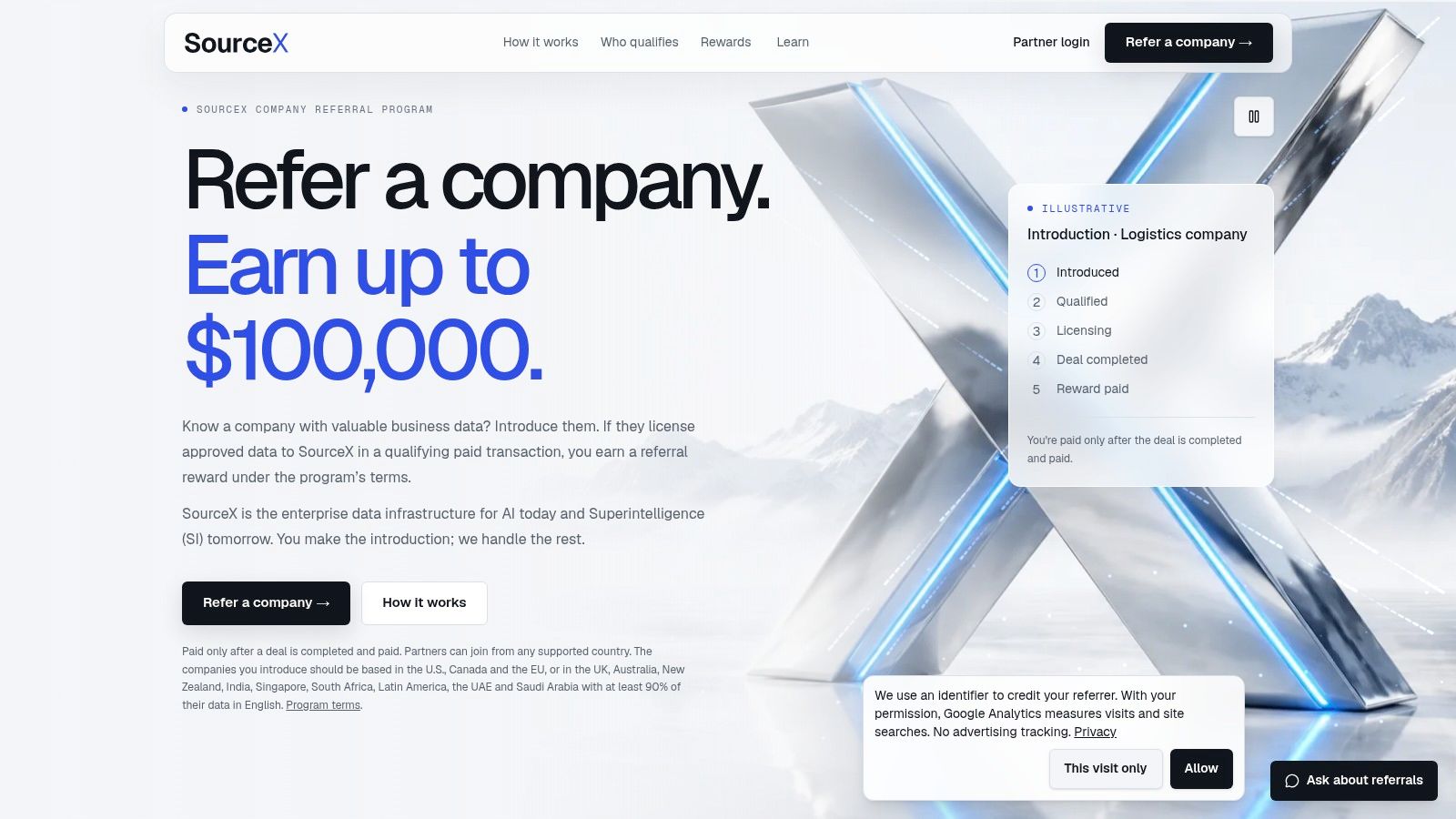
What partners should verify
SourceX provides a personal referral link, dashboard submissions, a 90-day attribution window, and reward stages marked Estimated, Eligible, Approved, and Paid. Payment becomes eligible only after buyer acceptance, cleared buyer payment, SourceX paying the referred company, and finance approval.
That sequence solves a common referral problem: the partner doesn't need to manage the licensing transaction personally, but the partner does need to introduce the right decision-maker and understand the conditions for payment. SourceX also offers a company fit checker, introduction email builder, network opportunity finder, data inventory builder, no-upload exploration tools, and supported AI assistant access through MCP integrations after sign-in.
Eligible companies can be located across the U.S., Canada, the EU, the UK, Australia, New Zealand, India, Singapore, South Africa, Latin America, the UAE, and Saudi Arabia. Outside the U.S., Canada, and the EU, at least 90% of the data must be in English.
If your network includes suitable knowledge-work companies, the get paid for referrals program is worth evaluating because the qualification and transaction work stays with SourceX. It isn't a fit for casual link sharing or introductions with no commercial relevance. Earnings depend on completed qualifying transactions, program terms, and approval. An introduction doesn't guarantee acceptance, a licensing deal, or payment.
Setting Up Tracking Links, Codes, and Agreements
Referral income disappears in the gaps between a promise and a record. Set up the evidence before you promote anything. A link dashboard, a promo code, your own analytics, and a saved copy of the agreement should tell the same story.
A practical setup sequence looks like this:
- Sign up and complete any approval or tax documentation.
- Generate a unique tracking link.
- Add campaign parameters for your own analytics.
- Generate a personalized code if the program supports one.
- Test the link and code in a controlled browser session.
- Screenshot the dashboard showing the active offer and terms.
- Save the agreement, payout rules, and approval email in one folder.
- Record the date, source, audience, and qualifying action in your referral tracker.
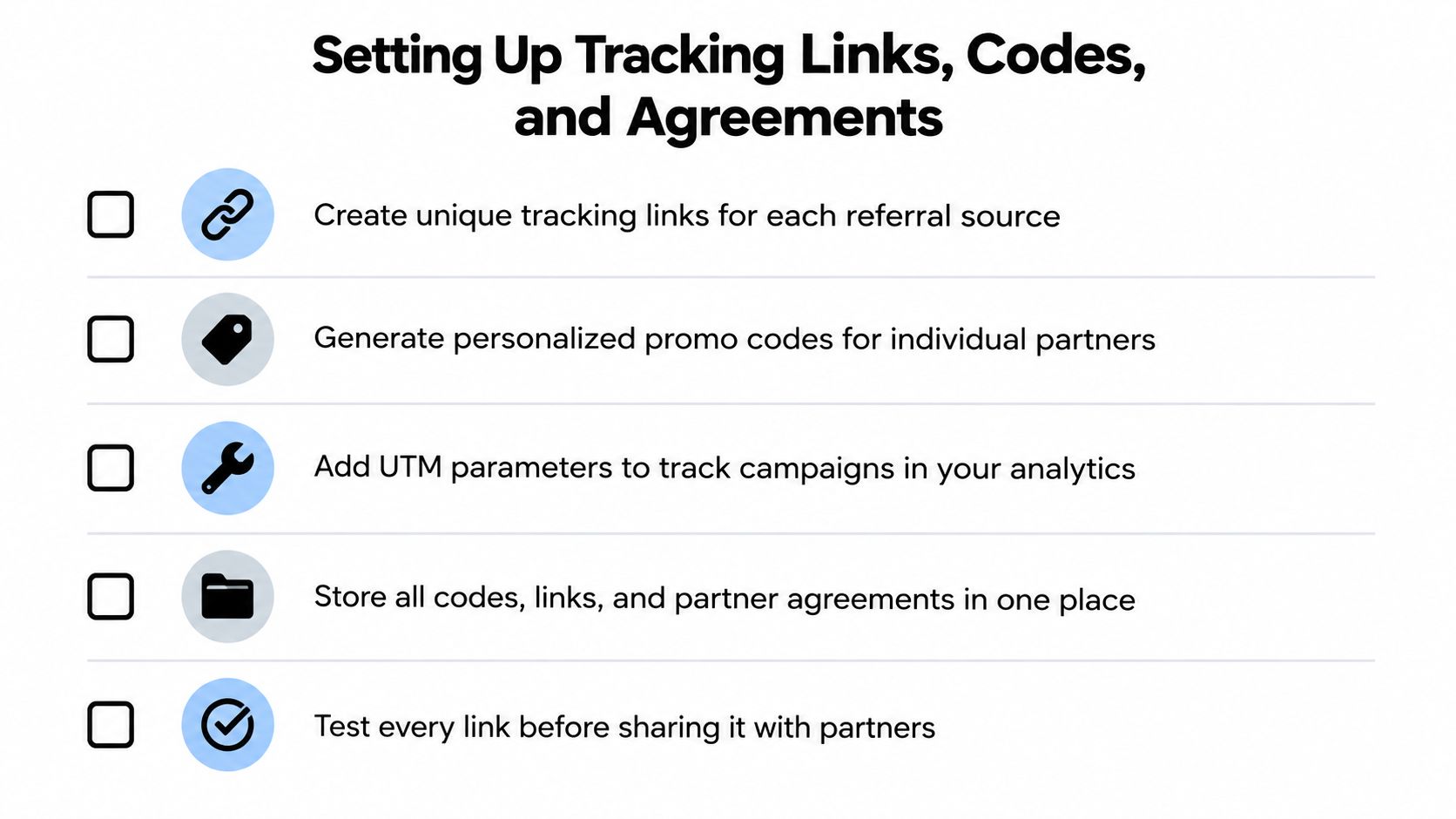
Use both platform tracking and your own records
The program's link identifies your referral inside its system. UTM parameters identify the campaign inside your own analytics. Use a consistent naming pattern that records the channel and audience, such as newsletter, direct message, podcast, or community post. Don't alter the program's core tracking parameters unless its documentation says you can.
A promo code adds a second proof point. It won't replace the tracking link, but it can help when someone changes devices, clicks from a private message, or completes a purchase after the cookie expires. Ask whether codes are exclusive, whether they override another partner's attribution, and whether the code applies to every eligible product.
| Step |
Action |
Why it matters |
| 1 |
Save the current program agreement |
Terms can change, and your record shows what you accepted |
| 2 |
Create a unique link for each source |
You can distinguish newsletter, social, community, and direct outreach activity |
| 3 |
Add UTM parameters |
Your analytics can connect traffic to a campaign |
| 4 |
Generate and test a promo code |
A second identifier can support attribution |
| 5 |
Record payout and refund rules |
You can forecast when approved earnings become payable |
| 6 |
Capture dashboard evidence |
Screenshots preserve status when reporting changes |
| 7 |
Note tax-document requirements |
Missing paperwork can delay payment |
Read the rules for self-referrals, coupon-site overwrites, refunds, payout schedules, and prohibited traffic. U.S. partners may be asked for a W-9, while non-U.S. partners may be asked for a W-8BEN. Those forms don't determine whether a program is worth joining, but failing to submit the required form can delay payment.
Keep one folder per program with the agreement PDF, screenshots, links, codes, payment records, and dispute correspondence. This setup takes less time than reconstructing attribution after a rejected commission.
Outreach Messages That Convert
The highest-paying program is often the worst program for your audience. A large bounty cannot make up for weak product fit, unclear attribution, a difficult approval process, or a recommendation that reads like a sales script.
Start with relevance. Name the problem, identify who has it, explain why the product may fit, state one limitation, and disclose your compensation in the same message. Give the reader enough context to make a sensible decision instead of pushing a link.

A warm direct message
I thought of you because you're dealing with [specific problem]. I've used or evaluated [product] for [specific use case], and it may help because [relevant capability]. The limitation is [honest drawback], so I wouldn't recommend it if [poor-fit condition]. I may receive a referral payment if you sign up through my link, so please compare it with alternatives before deciding: [tracking link].
This works because it respects the recipient's judgment. It does not imply that payment makes the product good, and it gives the reader a reason to investigate.
A public post or newsletter
If you're trying to [specific outcome], [product] is one option worth reviewing. It handles [concrete task] well, but [material limitation] may matter for teams that need [relevant requirement]. I receive compensation if someone becomes a qualifying customer through my referral link. Read the terms and choose it only if the fit is right: [tracking link].
Place the disclosure before or beside the call to action. Do not bury it after a long testimonial or hide it behind a separate page. A paid recommendation needs context at the moment people decide whether to click.
Use newsletters for considered recommendations, LinkedIn for professional use cases, podcasts for stories and demonstrations, and community posts when you can answer follow-up questions. Do not drop the same link into every channel. Match the channel to the buyer's decision process.
After a stalled conversation, send one useful follow-up rather than repeated pressure:
Sharing one detail that may help with your decision. [Product] is a better fit if [condition], and a poor fit if [condition]. If you want to compare alternatives, I can point you to them. My referral relationship is unchanged, so I may be paid if you qualify through my link.
A message that earns a response through specificity will outperform a broadcast that merely creates clicks. Track replies, qualified conversations, approved conversions, and rejected referrals. Click volume alone can make a weak program look productive.
Protecting Your Earnings From Fraud, Non-Payment, and Disclosure Risk
Referral fraud doesn't only harm program owners. It can also steal credit from legitimate partners. The 2025 report on affiliate fraud methods identifies cookie stuffing, brand bidding, click fraud, postback manipulation, and fake traffic as common problems. A separate vendor estimate says one-quarter of global ecommerce merchants experienced affiliate fraud in 2024, but that estimate should be treated cautiously because it comes from a vendor source.
Know how attribution gets stolen
Cookie stuffing places tracking identifiers without a meaningful user action. You can't always detect it directly, but you can avoid programs with weak reporting and ask how the platform validates clicks.
Coupon overwrites happen when a visitor who originally followed your recommendation searches for a discount code and another partner receives the final credit. Ask whether coupon publishers can overwrite existing attribution. A unique code can provide supporting evidence, but it won't help if the terms assign all credit to the last interaction.
Brand bidding occurs when partners buy paid search ads on a company's name or protected terms. Get written permission before running paid campaigns. If a program bans brand bidding, a commission generated through that traffic may be rejected.
Postback manipulation targets server-to-server conversion signals. Program owners should verify events against order, billing, and customer records. As a referrer, monitor unusual status changes and request the validation basis when a conversion is rejected.
Fake leads use fabricated or low-intent information. Protect yourself by documenting the source and context of introductions. Don't send scraped lists or incentivize people to submit forms they don't understand.
| Question |
What to look for |
Red flag |
| What counts as a conversion? |
A precise purchase, registration, lead, or accepted introduction |
“Qualified” without a definition |
| How is attribution assigned? |
Clear window, source priority, and duplicate rules |
Terms that can change without notice |
| Can coupon partners overwrite credit? |
Explicit rules for codes and last-click behavior |
No answer from support |
| What happens after a refund? |
A stated hold or clawback process |
Unlimited retroactive cancellation |
| How are leads validated? |
Evidence requirements and quality criteria |
Rejections with no explanation |
| When is payment due? |
Approval cycle, threshold, and payment method |
Vague “once processed” language |
| How do disputes work? |
Contact, deadline, and review evidence |
No documented escalation route |
If a commission is rejected, respond with a compact evidence package. Include the referral ID, date, source, tracking link, code, dashboard screenshot, relevant agreement, and any correspondence with the prospect. Ask for the exact rule used to reject the conversion and request a review within the program's stated dispute period.
If a customer later requests a refund, don't argue that the original effort should guarantee payment. Check the agreement. Some programs hold commissions until the return period passes, while others claw back a paid reward. Your job is to know the rule before you forecast income.
Disclosure is part of the product experience
Disclosure isn't a legal ornament. It tells people how to interpret your recommendation. Independent 2025 research from BBB National Programs found that 74% of surveyed U.S. consumers trusted influencer advertising at least somewhat, while 26% did not. The same research reported that 37% said undisclosed commercial relationships would make them feel deceived, and 33% would feel negatively toward the influencer. It also found that adding a brand partnership or standard #ad or #sponsored label didn't automatically increase perceived trustworthiness. Read the BBB National Programs Influencer Trust Index for the full context.
The practical standard is higher than “add a label.” Explain the financial relationship before the decision point, avoid claims you can't support, state material limitations, and say when you haven't personally used the product. In a private message, disclose directly. In a newsletter, place the disclosure near the recommendation. In audio or video, say it clearly rather than relying only on a description box.
Don't present a fixed bounty as proof that a product is valuable. A percentage commission can create a different incentive from a fixed payment, but both relationships deserve disclosure. If you're advising on investments, financial products, healthcare, employment, or another regulated area, obtain appropriate professional guidance before accepting paid introductions. General affiliate advice doesn't replace sector-specific rules.
A disciplined referral process belongs inside broader risk management for startups. Keep an escalation playbook, preserve the accepted terms, and treat unexplained cancellations as a reason to reduce promotion or leave the program.
Tax Basics and Measuring What Pays
Referral income becomes useful when you can answer three questions: what did you earn, what did it cost to produce, and what should you do next? Start with records, not optimism.
U.S. tax treatment depends on your legal structure and activity, so confirm your position with a qualified tax professional. In general, an individual carrying on a referral or affiliate business may report business income and expenses through the applicable federal forms, often including Schedule C. A payer may issue Form 1099-NEC when its reporting requirements are met, but receiving or not receiving that form doesn't by itself determine whether income is reportable. Non-U.S. readers should check the equivalent rules in their jurisdiction.
Track every payment, refund, platform fee, software subscription, contractor cost, advertising expense, and content-production cost. Keep invoices and payment records with the program agreement. Don't claim an expense merely because it relates loosely to your business. Ask your tax adviser whether the expense is ordinary, necessary, and properly documented for your situation.
Measure quality instead of vanity metrics
A dashboard full of clicks can conceal a weak business. Use a small set of measures that connect activity to cash and time.
| Metric |
How to calculate |
Healthy benchmark |
| Earnings per click |
Approved referral earnings divided by tracked clicks |
No universal benchmark. Compare programs and channels over time |
| Earnings per referred customer |
Approved earnings divided by approved customers |
Higher is useful only if customer quality and retention remain sound |
| Refund-adjusted commission |
Paid commission minus refunds, clawbacks, and reversals |
Should become more stable as you understand the program's hold period |
| Effective hourly rate |
Net referral income divided by hours spent finding, explaining, and supporting referrals |
Compare with your consulting or content-production alternatives |
Use approved earnings rather than pending commissions when you compare programs. Pending balances can disappear through refunds, duplicate reviews, or customer-quality checks. Separate each channel in your records so you can tell whether a newsletter, direct introduction, podcast mention, or community post produces the right kind of customer.
Referral quality matters because conversion rates can be modest even in established programs. One SaaS benchmark estimates that roughly 8 out of every 1,000 visitors referred by SaaS affiliates become paying customers, an average referral-to-sale conversion rate of about 0.8%. Rewardful's affiliate marketing benchmarks says this figure applies specifically to SaaS affiliate referrals, so don't treat it as a universal target.
The same source reports that affiliate marketing influenced approximately 16% of global ecommerce sales in 2021, while historical survey data found that more than 80% of advertisers and 84% of publishers operated affiliate programs. Those figures support a practical conclusion: a small conversion rate can still matter when the audience and economics are large, but traffic without customer quality won't build durable income.
Decide what deserves more effort
Review each program through four filters:
- Commercial value: Does the approved customer produce enough income to justify your work?
- Audience fit: Can you recommend the product to people who have the relevant problem?
- Operational reliability: Do attribution, reporting, approval, and payment work predictably?
- Trust cost: Would the recommendation weaken your relationship with the audience if the product disappointed them?
For founders, a one-time-payment platform can use a fixed bounty for verified customer referrals. IndieMerger, for example, connects verified founders with potential co-founders and offers tools such as profiles, search filters, private messaging, and product showcasing. If you evaluate a referral arrangement for a product like that, define the verified referral, payment trigger, attribution evidence, and refund treatment before promoting it.
The strongest referral business isn't built by adding more links. It comes from choosing a narrow set of products, documenting the terms, disclosing the relationship, measuring refund-adjusted earnings, and removing offers that create more trust risk than revenue.
If you're ready to get paid for referrals, choose one program your audience already needs, save its agreement, create a unique link and code, and send a relevance-first recommendation with clear disclosure. Review the first approved conversions, rejected referrals, payout timing, and audience feedback before adding another offer.