You've got a service people want, a landing page half-written, and a checkout flow that still feels like a polite suggestion instead of a decision. That's where most founders sit when they try to sell services online. The work is real, the skill is real, and the revenue stays uneven because the system around the offer is missing.
The fix isn't “post more” or “pick a better platform” in isolation. Treat it as a revenue system, where the offer, the proof, the page, the checkout, and the delivery all have to work together. The online service market is expanding fast, with a 2024 analysis estimating the worldwide freelance-platform market at about US$5.4 billion and projecting US$13.3 billion by 2030 at an implied 16.1% CAGR Research and Markets. That growth matters because buyers are already comfortable purchasing expertise through digital workflows.
Table of Contents
Why Selling Services Online Is a 2026 Founder Power Move
A founder who still thinks locally is leaving money on the table. The city-by-city search for clients creates a fragile business, because every new inquiry changes the offer and every slow month forces another reset. Online selling fixes that by letting you package the work once, prove it once, and sell the same outcome to a much larger buyer pool.
The market is bigger than freelance gigs
Service buying is now a normal digital transaction. Buyers expect to purchase design, software, consulting, marketing, writing, administration, and other professional work online, and the genuine opportunity sits in the system around that transaction. The forecast cited earlier already shows where this is going, and the right takeaway is simple, the platform layer matters, but the service itself is what customers are paying for.
That matters because the founder advantage is operational. You do not need inventory, a warehouse, or a full team before you test a paid offer. You need a tight outcome, a buyer who feels the pain, and a transaction that is easy to complete. If you are building with partners, the model gets even stronger, because one person can deliver the service first, then share or hand off the work as demand grows.
Practical rule: if you can describe your offer, your buyer, and the promised result in one sentence each, you are ahead of most service sellers.
Why this is a founder move, not a freelancer move
The difference is packaging. A freelancer sells hours. A founder sells a repeatable outcome with a clear entry point, a defined scope, and a fulfillment system around it. That is a different business, and it is the difference between staying busy and building profit.
The online market is not being driven only by giant buyers. One forecast put the global freelance-platform market at US$7.64 billion in 2025 and projected US$18.97 billion by 2031, with small and medium-sized enterprises accounting for 65.02% of market activity in 2025 Mordor Intelligence. That is the signal. Smaller businesses want outside skill without permanent hiring, and that is exactly where service founders should sell.
The right goal is not to be everywhere. Pick one service, one buyer type, and one acquisition path, then make the whole system measurable. If you cannot describe the service, the buyer, and the funnel in a few words, you do not have a business yet. You have a skill set waiting for structure.
Choosing a Service Model and Validating Real Demand
Start with what someone will pay for next week. Too many founders build a polished offer page for a service buyers cannot evaluate fast enough to purchase. The better move is to choose a format that matches your skill, the buyer's risk tolerance, and the net revenue you keep after fees and fulfillment.
Pick the service shape first
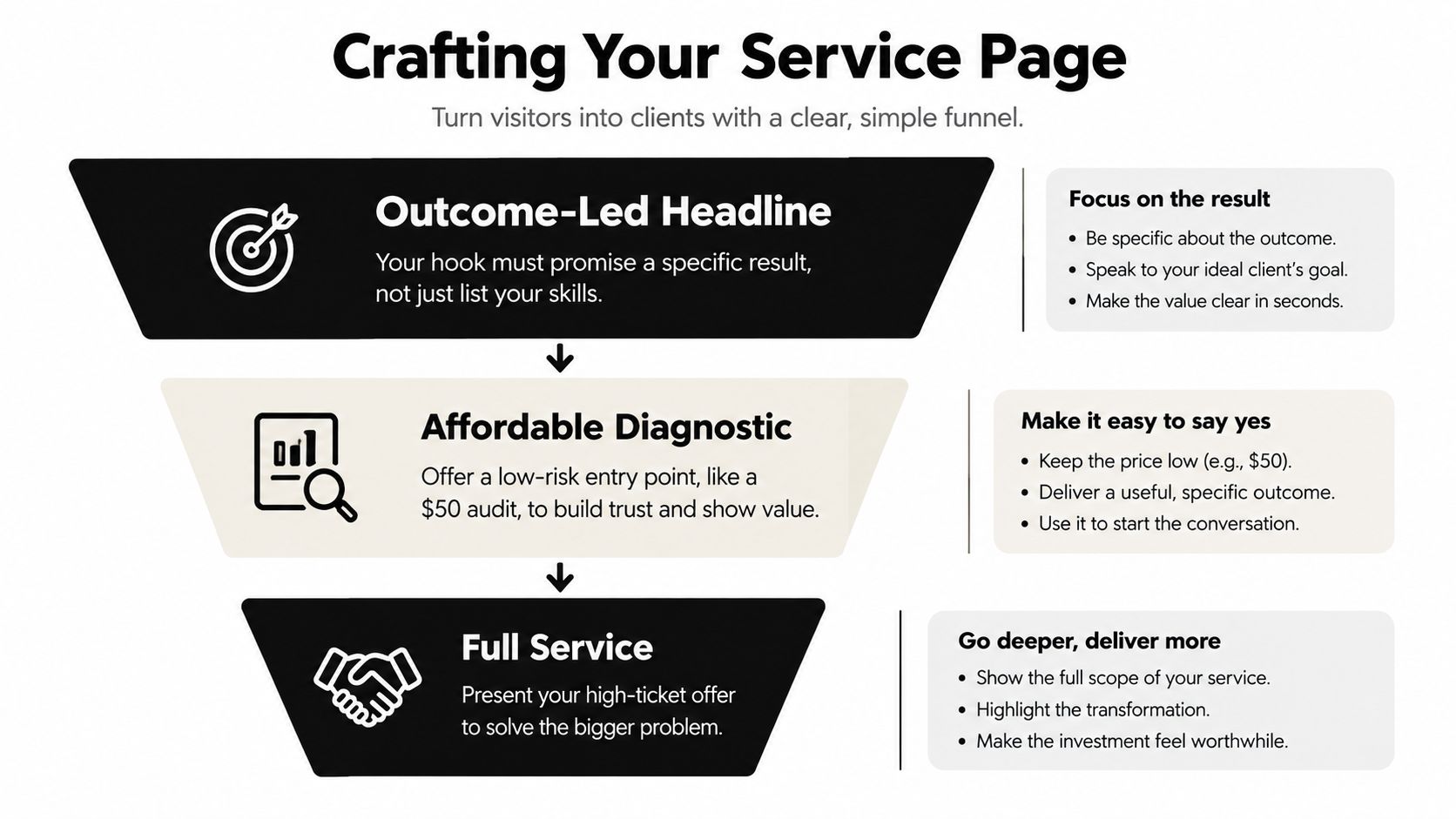
Three service shapes matter: done-for-you, done-with-you, and done-together. Done-for-you fits buyers who want the result and do not want to learn the process. Done-with-you fits buyers who want guidance but still stay involved. Done-together works when the outcome depends on collaboration, such as strategy, positioning, or implementation across two people or teams.
Here is the rule I would use. If the buyer is impatient, sell done-for-you. If the buyer is cautious, sell a low-risk diagnostic first. If the buyer wants control, sell a guided engagement. Do not force every service into a high-ticket package on day one. A small paid diagnostic often earns trust faster than a big promise with no proof.
To pressure-test demand, use three checks.
- Competitor scan: list the offers already being sold, then note the language they use, the proof they show, and the gaps they leave.
- Paid smoke test: put a small budget behind one narrow promise and see whether qualified people click through.
- Buyer conversations: speak with real prospects, not friends. Ten direct conversations will teach you more than another week of brainstorming.
If you want a structured starting point for the buyer side of that work, use this startup market research guide to keep your questions focused. The point is not to admire the data. It is to decide whether the offer deserves packaging.
Write the one-page Service Model Brief
Keep it brutally simple. One page is enough. Include the buyer type, the pain point, the service shape, the promised outcome, the delivery timeline, the likely objections, and the proof you can show without overselling. If you cannot fill that out in an afternoon, the offer is still too vague.
My rule: if the buyer cannot say “yes, that's my problem” in under a minute, tighten the offer before you touch pricing or design.
Use the market signal as a sanity check, not a script. If paid diagnostics in your niche are selling at all, buyers in this format are already comfortable paying before delivery. Your job is to make the offer feel safe, not broad. That means making the promise specific, showing real proof, and removing avoidable friction from the first purchase.
Crafting Your Service Page, Pricing, and Sales Funnel
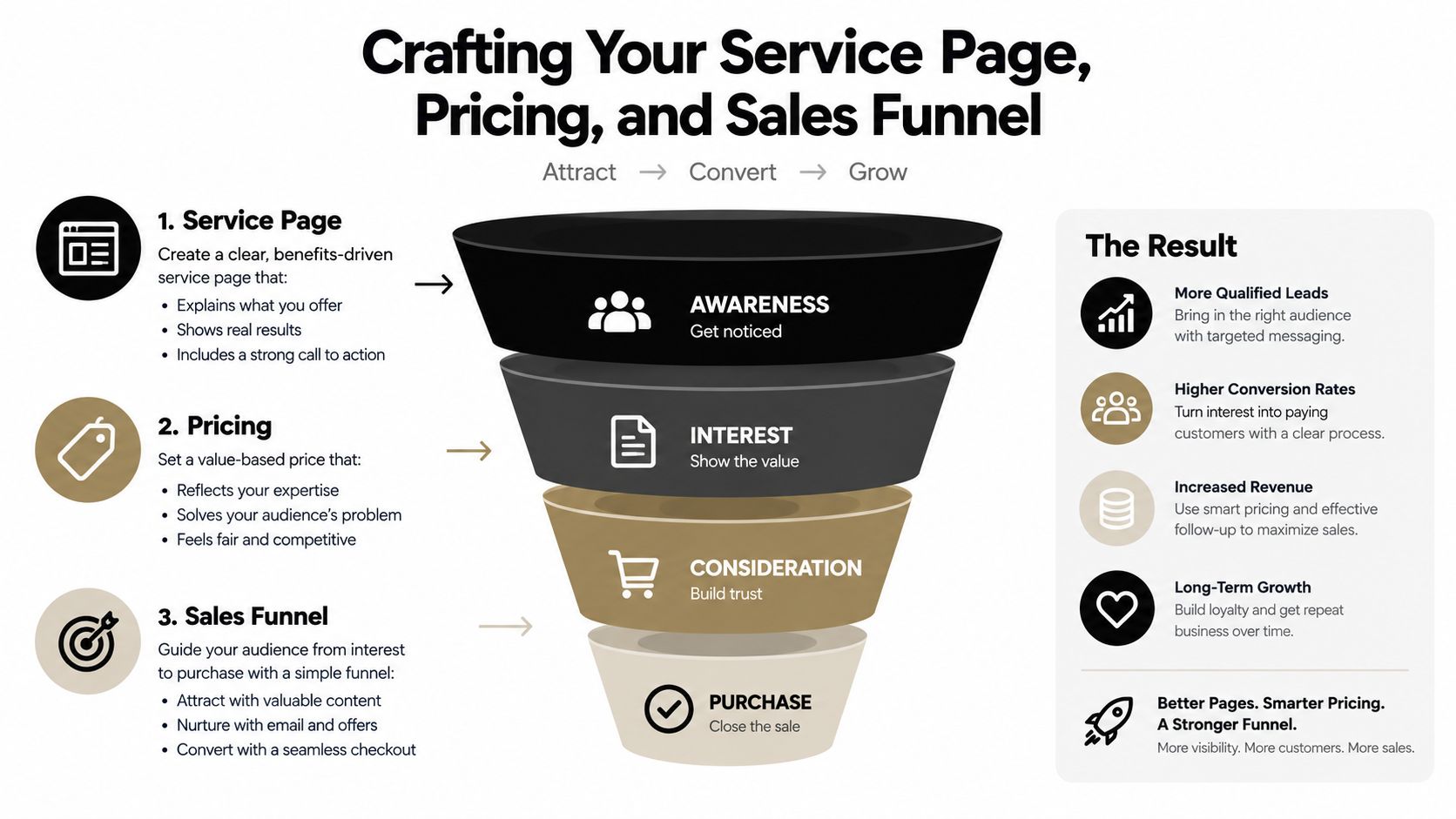
Your service page shouldn't read like a résumé. It should read like a promise with proof. If the page starts with skills, credentials, or a long backstory, you've already lost the buyer's attention. Lead with the outcome, then remove the friction between interest and payment.
Write the page around one outcome
Start with a headline that names the result, not the discipline. “Launch a qualified lead pipeline for your B2B service” is stronger than “Fractional marketing support.” The first says what changes. The second says what you are. Buyers pay for the change.
Then build the page in layers. Use a short subhead to name who it's for. Add a proof block with examples, process, or prior outcomes you can show. Finish with one clear next step. If the offer is not ready for a full commitment, route people to an application or call instead of forcing payment on the first visit.
Price against value, not time
If you're still pricing only by hours, you're leaving money on the table and inviting the buyer to compare you with labor. That's a weak frame for services with judgment involved. Price the outcome, then use tiers to make the decision easier.
A practical structure is:
- Entry tier: a diagnostic, audit, or short review that lowers risk.
- Core tier: the main service with clear scope and delivery.
- Premium tier: implementation plus support, follow-up, or ongoing access.
The funnel should match the offer. A narrowly defined outcome on the page should lead to a proof-oriented landing page, then to email capture or application, then to segmentation by urgency, stage, or fit, then to a guided demo or consultation, and finally to the offer. That flow works because it respects buyer hesitation instead of pretending every visitor is ready to pay.
Practical rule: don't report one blended conversion number. Track visitor-to-lead, lead-to-qualified-profile, qualified-profile-to-payment, and refund rate separately.
That matters because a practical benchmark for B2B websites is 2–5% visitor-to-lead, while technology and SaaS sites often sit nearer 1–3%. Also, fewer than 4 in 100 leads typically become customers, which is exactly why qualification and follow-up matter SERP Sclulpt. If you measure only traffic, you'll miss the part of the funnel that drives revenue.
For the page itself, keep the CTA specific. “Apply for the audit” is better than “Learn more.” “Book a consultation” is better than “Contact me.” If the buyer has to guess what happens next, they won't click.
Use this startup marketing plan resource to pressure-test whether your traffic source actually matches the promise on the page. The better the match between channel and offer, the less you need to persuade later.
How AmaJova Can Help
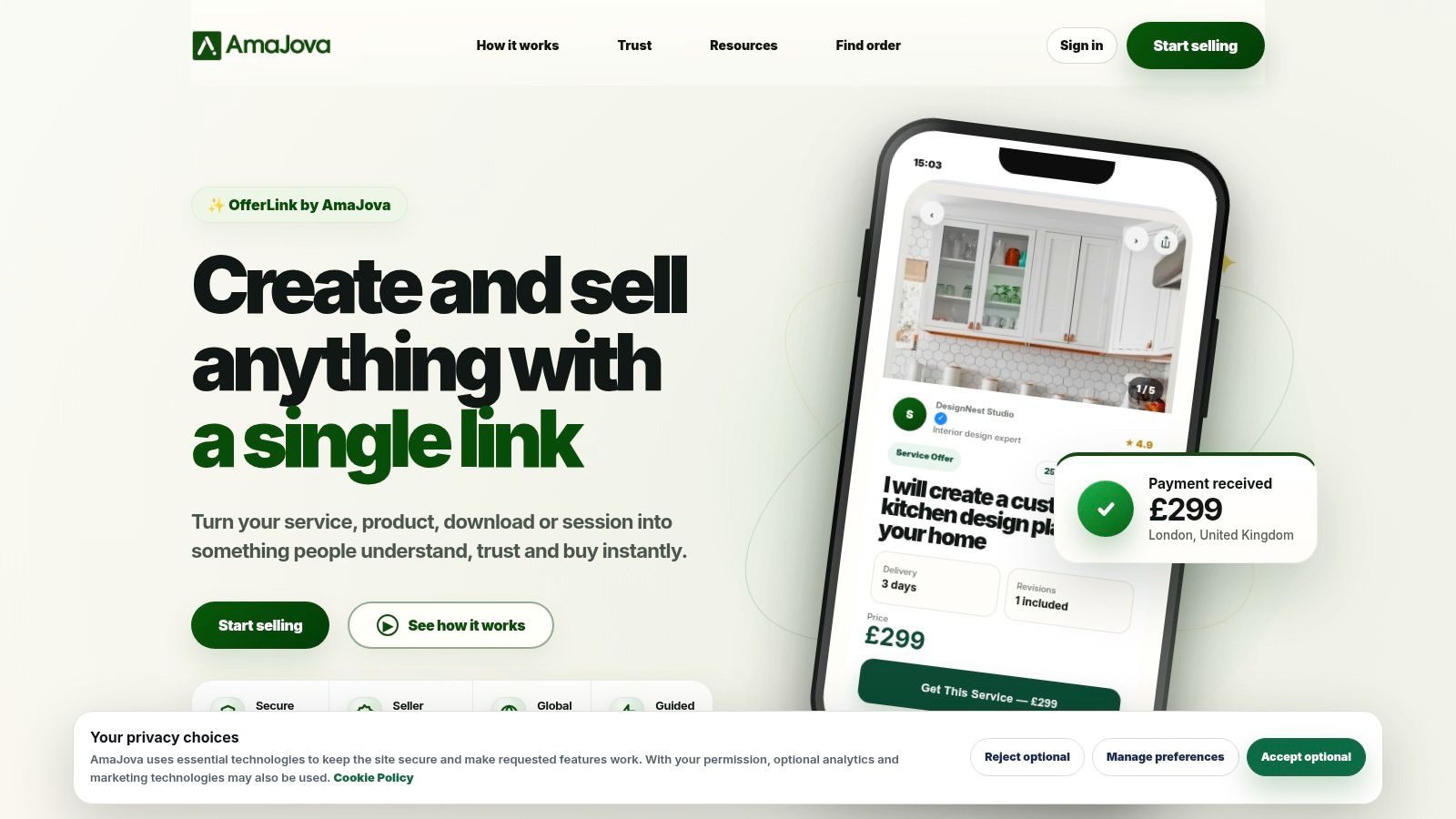
Some sellers don't need a full website first. They need a clean way to define the offer, set expectations before payment, and keep fulfillment tied to the order record. That's where AmaJova fits. It turns services, physical products, digital products, and live sessions into a single OfferLink, with secure checkout, order management, verification, and global payments across 150+ currencies.
For a founder trying to sell services online with AmaJova, the useful part is not the branding, it's the structure. OfferLink pages let you specify the title, description, inclusions, price, and fulfillment or booking details. That makes the offer understandable before checkout, which is exactly where many service sales break. If you want to see the product flow in context, sell services online with AmaJova shows the setup in a practical way.
The system is most useful when the selling problem is clarity, not custom development. It supports order messages, delivery steps, payment records, dispute status, and completion tracking, so buyer communication doesn't get scattered across email and chat. It also includes trust signals, buyer and seller protection information, and a seller progression program. If you're selling one clear offer and don't want to build a full storefront, that's a strong fit.
Where it stands out
AmaJova is most relevant when you want one shareable link instead of a full website, clear scope before payment, and a unified transaction record across different offer types. It can also help when cross-border payments and payout handling would otherwise slow you down. The trade-off is obvious. If you need a deep custom site with broad content and SEO architecture, a dedicated website may still make more sense.
A simple decision rule helps here:
| Option |
Best fit |
What you give up |
| Marketplace |
Fast discovery and built-in traffic |
Lower control over branding and customer relationship |
| Own site |
Full control over positioning and data |
You must generate traffic and manage setup |
| Direct outreach |
High-touch sales for narrow offers |
Harder to scale and track |
| OfferLink-style page |
Clean, structured selling with lighter technical overhead |
Less flexibility than a custom storefront |
If your offer is straightforward and the main problem is turning interest into a clear, protected transaction, a structured offer page is enough. If your service is more complex, you may still want your own site in parallel.
Choosing Platforms and Payment Processors by Net Revenue
Headline fees are a trap. Sellers compare commissions and ignore the rest of the math, then wonder why the payout feels thin. The question that matters is not “what does the platform charge?” It's “what do I keep after commission, payment costs, currency conversion, refunds, and the time spent chasing prospects?”
Commissions alone commonly range from 5% to 20%, and international currency-conversion costs can add roughly 2% to 4% Jobbers. That means the cheapest-looking channel is often not the best one. A high-fee marketplace can still win if it brings qualified demand, handles disputes, or reduces collection friction. A low-fee setup can still lose if you do all the work to find the buyer and then absorb the payment mess yourself.
Compare channels by net take
| Channel |
Typical Commission |
Lead Flow |
Dispute Protection |
Net Revenue Profile |
| Marketplace |
Higher, often visible upfront |
Built-in discovery, but competitive |
Usually stronger than direct outreach |
Good when traffic and trust matter more than margin |
| Own site with processor |
Lower platform cut, more direct fees |
You generate your own traffic |
Depends on your setup |
Better control, but you carry acquisition cost |
| Direct outreach |
No marketplace commission |
You own the prospect list |
Weak unless you build it yourself |
Highest control, but the most selling effort |
The practical move is to compare channels on net revenue per project, not gross price. That means you should account for the platform cut, the client-side fee if any, payment processing, currency conversion, withdrawal charges, taxes, refunds, and unpaid proposal time. If you don't measure those together, you're guessing.
Pay for protection when the transaction needs it
Paying a higher fee is rational when the platform reduces real risk. Dispute handling, payment protection, and faster collection can be worth more than a few percentage points if the buyer is new or the project is ambiguous. The wrong move is choosing the cheapest processor for a service with high buyer uncertainty, then eating chargebacks and messy follow-up later.
This is also where payment-method coverage matters. If your target buyers expect cards, wallets, or local methods and you don't support them, the sale can die at checkout. Don't treat payment as plumbing. It's part of the offer.
If you're selling internationally, compare net payout by country and payment method, not just platform fee.
That's the kind of thinking most guides skip, and it's the one that protects margin. The low-fee option is not always the high-income option.
Making an Intangible Service Verifiable Before the Buyer Pays
The biggest friction in service sales is simple. Buyers can't touch the result before they buy it. That makes polished language cheap and proof expensive. Your job is to make quality observable before the payment clears, without giving away the whole job for free.
Build a proof stack
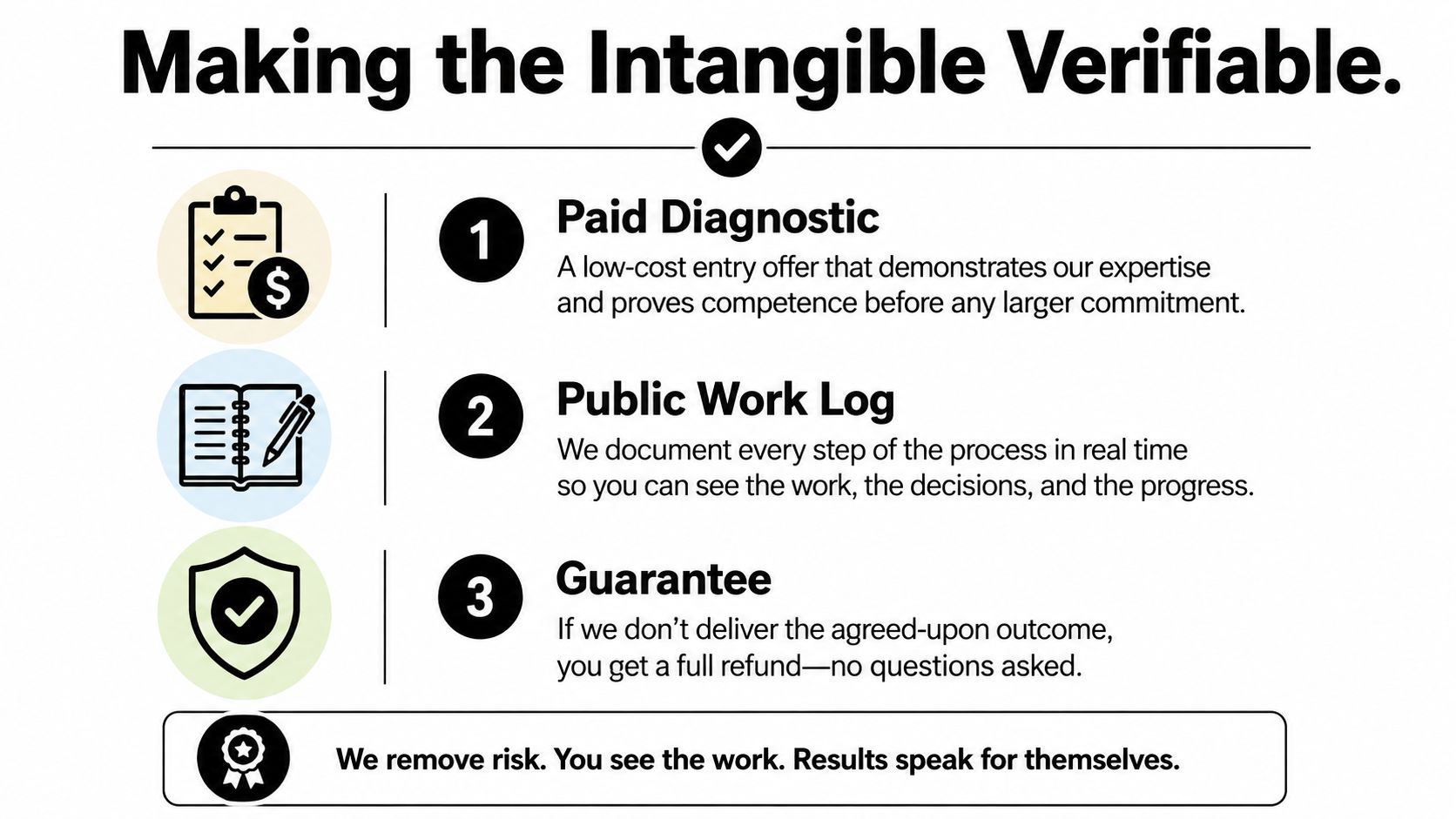
The strongest sellers use a Proof Stack instead of relying on a single testimonial or portfolio page. The stack can include a paid diagnostic, a public work log, specific references, milestone-based contracts, and clear acceptance criteria. Each piece reduces uncertainty in a different way.
Use this sequence:
- Paid diagnostic: a low-risk entry that proves competence without giving away the whole solution.
- Public work log: a visible record of how you think and what you delivered.
- Specific reference: someone who can answer detailed questions, not just praise you generically.
- Acceptance criteria: a short list of what “done” means before the work starts.
The paid diagnostic is the one I'd start with. It lets the buyer test you without a full commitment, and it protects you from endless free samples. If you give away too much in the name of proof, you train buyers to expect unpaid labor.
Make the objection easier to answer
The classic objection is, “How do I know this will work for me?” Don't answer with hype. Answer with structure. Explain what you'll assess, what the buyer will receive immediately, what gets verified, and what happens if the fit isn't there. Buyers don't need a sales speech. They need to understand the mechanism.
Marketplace advice often focuses on where to list services and what fees are charged, such as a 20% seller commission on one major freelance platform, but that misses the deeper problem of pre-purchase trust, especially as AI makes shallow proposals look more convincing Fiverr resources. That gap is why proof has become more important, not less.
For design, engineering, marketing, consulting, or operations, the form of proof will vary, but the principle is the same. Make the next step concrete enough that the buyer can judge it before they commit.
Engineering a Checkout That Closes the Sale
Checkout is part of the sale. If a buyer reaches payment and hesitates, the problem is the checkout, not the traffic. The page has to clear the last objections quickly, or the deal stops there.
Audit the final step like a buyer would
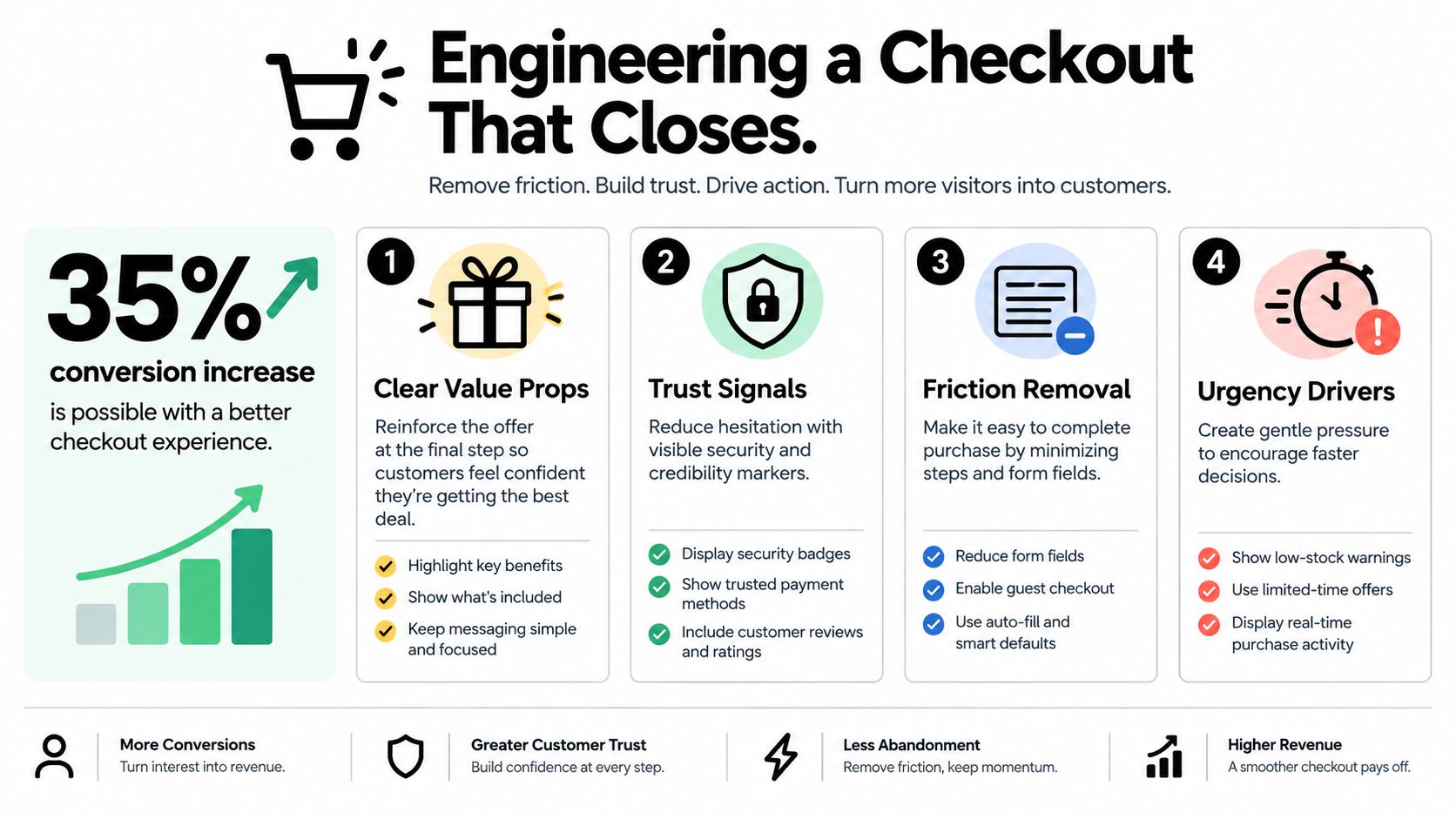
Baymard's research says the average large e-commerce site can potentially improve conversion by about 35% through checkout UX improvements, and roughly 70% of users abandon after adding items to a cart Baymard. For services, that means the payment page should feel obvious, calm, and complete.
Run this checklist:
- Show the total price and renewal terms before payment.
- Explain exactly what lifetime access includes if you use that model.
- Offer a guest or low-friction account path.
- Minimize fields and steps.
- Support the payment methods buyers expect in your target market.
- Display security, verification, refund, and privacy information at the decision point.
- Test the full flow on mobile and slow connections.
Unexpected additional charges, forced account creation, lengthy processes, and unavailable preferred payment methods are all material abandonment drivers, per the same Baymard research. Hidden verification steps are a bad move too. If buyers discover after paying that they still have hoops to jump through, you add friction at the worst possible moment.
Measure the points that actually leak money
Track checkout-start-to-payment completion, payment errors, field-level abandonment, device type, country, and support-contact rate. Then change one friction variable at a time. If you change the price, the copy, and the form structure in one test, you will not know what helped.
I would also keep a short support note right next to the payment call to action. “What happens after you pay?” is a real question. Answer it there, not in a separate FAQ the buyer may never open.
Delivery, Onboarding, Support, and Scaling Without Burnout
A sold service can still become a mess if delivery is loose. The fix is scope control, fast onboarding, and a weekly review of what's slipping. If you don't systematize this, every new client turns into a custom project and your calendar becomes the bottleneck.
Protect the scope early
Start with a simple contract or written agreement that says what's included, what isn't, and what happens when the buyer changes direction. Then make onboarding tight. The first 48 hours should set expectations, collect needed inputs, and define the next milestone. If the buyer is still confused after that, the service is too vague.
Keep support boundaries visible. A lot of burnout comes from open-ended messaging, not from the actual work. If a client needs deeper support, move them into a structured channel or a separate package. That's how you avoid turning delivery into constant interruption.
For a founder using partners or collaborators, this marks the point where the business starts to feel like a system instead of a solo grind. This team workload guide is useful if you're deciding how to distribute client work without losing control of quality. The point is to make handoffs possible without making the offer feel fragmented.
Scale in stages
Month one, stabilize the delivery steps. Month two, tighten onboarding and support. Month three, add a second offer or a partner who can handle a defined part of the workflow. Don't add complexity before the first offer is repeatable.
The weekly review should be boring in the best way. Check where leads stall, where checkout drops, where clients need extra clarification, and where fulfillment takes longer than expected. That's how you grow without becoming the entire operating system.
Bottom line: the service business scales when the promise, the proof, the checkout, and the delivery all stop depending on your memory.
If you're ready to sell services online with less guesswork, start by tightening one offer, one proof asset, and one checkout flow this week. Publish the outcome clearly, remove the hidden friction, and make the payment path feel obvious. Then run the numbers on net revenue, not vanity traffic, so you can see what's working and double down on it.