Most advice about a data monetization strategy starts in the wrong place. It tells founders to identify a valuable dataset, build an API, and find buyers. That sequence turns a business question into an engineering project before anyone proves that a customer will pay, that the data can be used lawfully, or that delivery costs won't erase the margin.
Data monetization is better treated as a portfolio decision. You're choosing where existing data can produce revenue, reduce operating cost, lower risk, or make the core product more valuable. Sometimes the answer is a licensed report. Often it's a premium feature, a better internal decision, a partner offer, or a product that you decide not to build because the evidence is weak.
Table of Contents
What a Data Monetization Strategy Really Means in 2026
Selling raw records to strangers is the least interesting definition of data monetization, and usually the riskiest one for a solo founder. The operator definition is broader: any repeatable commercial or operational value created from data the company already collects.
That value can appear as a new revenue line, lower support effort, sharper pricing, better matching, reduced compliance exposure, or faster product decisions. A benchmark report can qualify. So can an algorithmic recommendation embedded in an existing subscription. If data improves a decision that customers pay for, it belongs in the conversation.
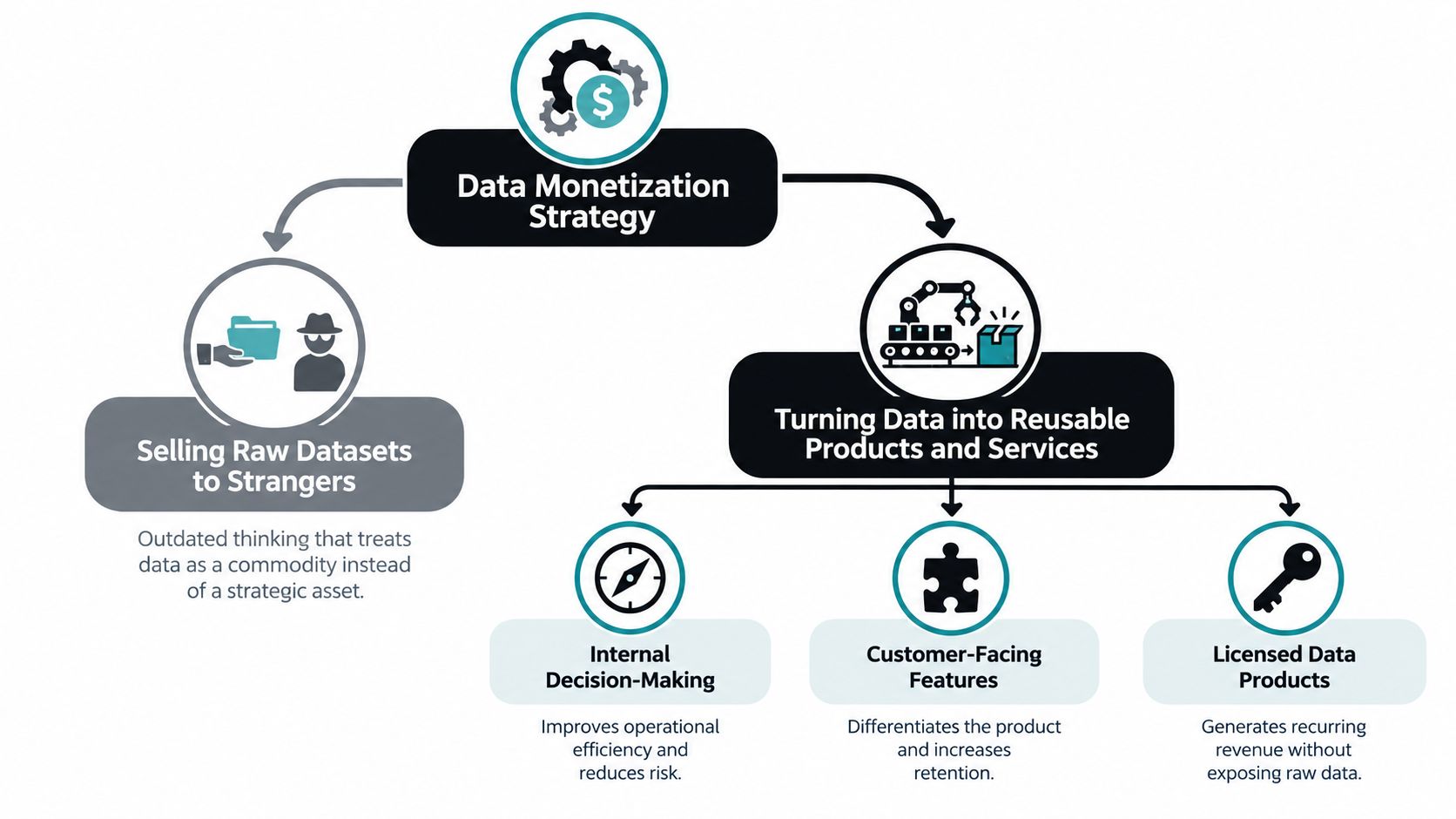
The market evidence supports the strategic shift, but it doesn't justify blindly launching a data business. One industry estimate valued the global market at approximately USD 2.9 billion in 2022 and projected it to reach USD 7.3 billion by 2027, implying a 19.5% compound annual growth rate. Another forecast estimated the 2022 market at USD 2.0925 billion and projected USD 9.4214 billion by 2030, with an 18.2% CAGR. The estimates differ because analysts include different combinations of software, services, marketplaces, governance, exchanges, and consulting. Both forecasts point to expansion, not to a universal business case for every dataset. Market sizing and forecast definitions
The four outcomes worth tracking
A useful strategy starts by separating four outcomes:
- Revenue: Sell access to an insight, report, feature, benchmark, API, or managed data service.
- Cost: Use behavioral or operational data to reduce manual work, support demand, waste, or acquisition inefficiency.
- Risk: Detect bad actors, weak data, compliance exposure, fraud patterns, or poor-quality decisions earlier.
- Velocity: Help the team validate ideas, prioritize features, and match customers with better options.
Raw data rarely creates value by itself. A buyer pays for a decision, not for a pile of rows. That decision might be which market to enter, which candidate to contact, which customer needs attention, or which partner deserves budget.
For a founder platform, potentially valuable assets include verified profile attributes, search behavior, matching signals, skill gaps, engagement events, and outcome feedback. Those assets don't automatically become a product. They need a defined audience, a clear use, careful aggregation, and an agreement about what users permitted the company to do.
Treat monetization as a portfolio, not a project
A portfolio approach forces comparison. Should the team use its data to improve conversion, create a premium insight, sell a partner report, or reduce operational effort? Each option has a different payback period, risk profile, and technical burden.
The strongest first move is usually the one closest to an existing workflow. It has a known user, an observable decision, and a shorter path to feedback. A standalone marketplace is farther away from all three.
Operator rule: Don't build a data product until you can name the paying user, the decision they'll make, and the evidence that your data improves that decision.
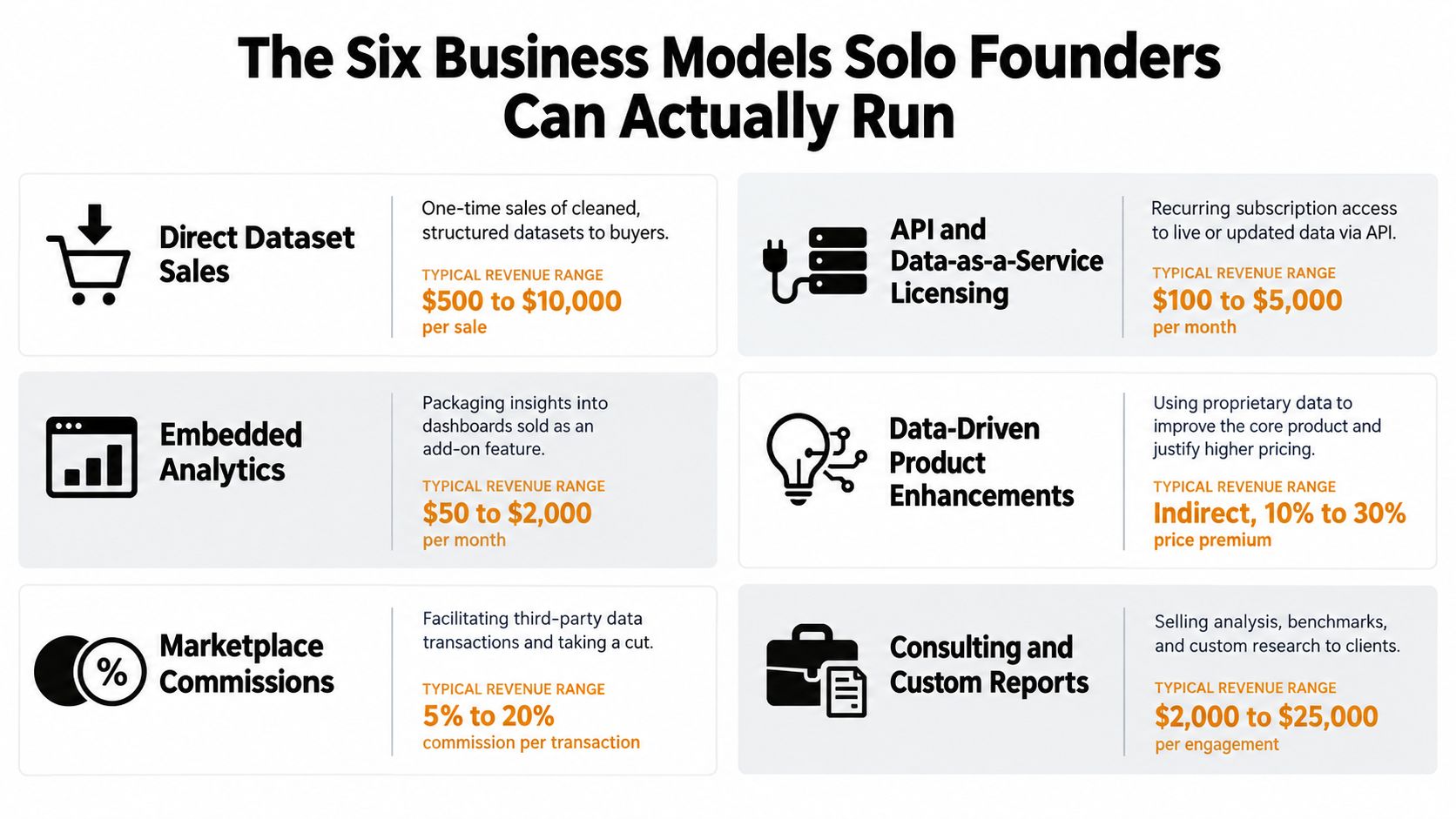
The Six Business Models Solo Founders Can Actually Run
Strategy without a business model is just enthusiasm with a backlog. Solo founders should rank options by capital intensity, delivery complexity, and governance exposure, not by how impressive the architecture sounds.
Start with the models closest to the core product
Internal optimization is the cheapest model because no external buyer is required. Use data to improve matching, pricing, retention, prioritization, or support. It produces value through the existing business, so the founder can test it with spreadsheets, SQL exports, or manual reviews before creating a new offer.
Embedded insights come next. Add benchmarks, recommendations, alerts, or dashboards to a product customers already understand. A founder platform might turn aggregated activity into a premium market view rather than asking users to buy a separate database.
Consulting and custom reports can validate demand quickly, but they're dangerous as a final model. A founder can sell a custom analysis, learn which questions recur, and then convert repeated work into a standardized report. If every customer needs a different analysis, the business has created a services practice, not a scalable data product.
Choose external models only after demand is visible
Data-enabled partnerships let another company use your insights inside a joint offer. This can work when the partner already owns distribution, such as an accelerator, recruiting firm, or startup program. The tradeoff is negotiation time and dependence on another company's sales process.
API or data-as-a-service licensing creates recurring access to structured data. It becomes attractive when customers need regular machine-readable updates and the provider can enforce permissions, quotas, quality controls, and support boundaries. It's a poor first step when the founder hasn't confirmed the buyer's workflow.
Direct dataset sales are the most obvious and often the least forgiving. A one-time file sale can create immediate revenue, but it may expose sensitive information, invite copying, create support obligations, and produce no recurring relationship. Sell only data you can document, permission, refresh, and defend.
A BARC survey of 200 European companies found that analytics-based monetization was the most common approach, used by 40% of respondents, while 17% had already launched formal data-monetization initiatives. The survey was conducted in 2018, so it isn't a current global census, but it supports a practical sequence: organizations commonly begin with analytics and decision support before attempting direct data sales. BARC's adoption findings
Use a simple selection filter
Score each model against four questions:
- Does it use data already collected?
- Can the founder reach the buyer without building a new sales channel?
- Can the output avoid exposing identifiable records?
- Can delivery become repeatable after the first customer?
If the answer is “no” to most of these, skip the model for now. The best early data monetization strategy is rarely the most technically ambitious one. It's the model that creates a paid learning loop without placing the company's runway, trust, or legal position at risk.
The Five-Link Value Chain That Decides Whether Data Is Worth Selling
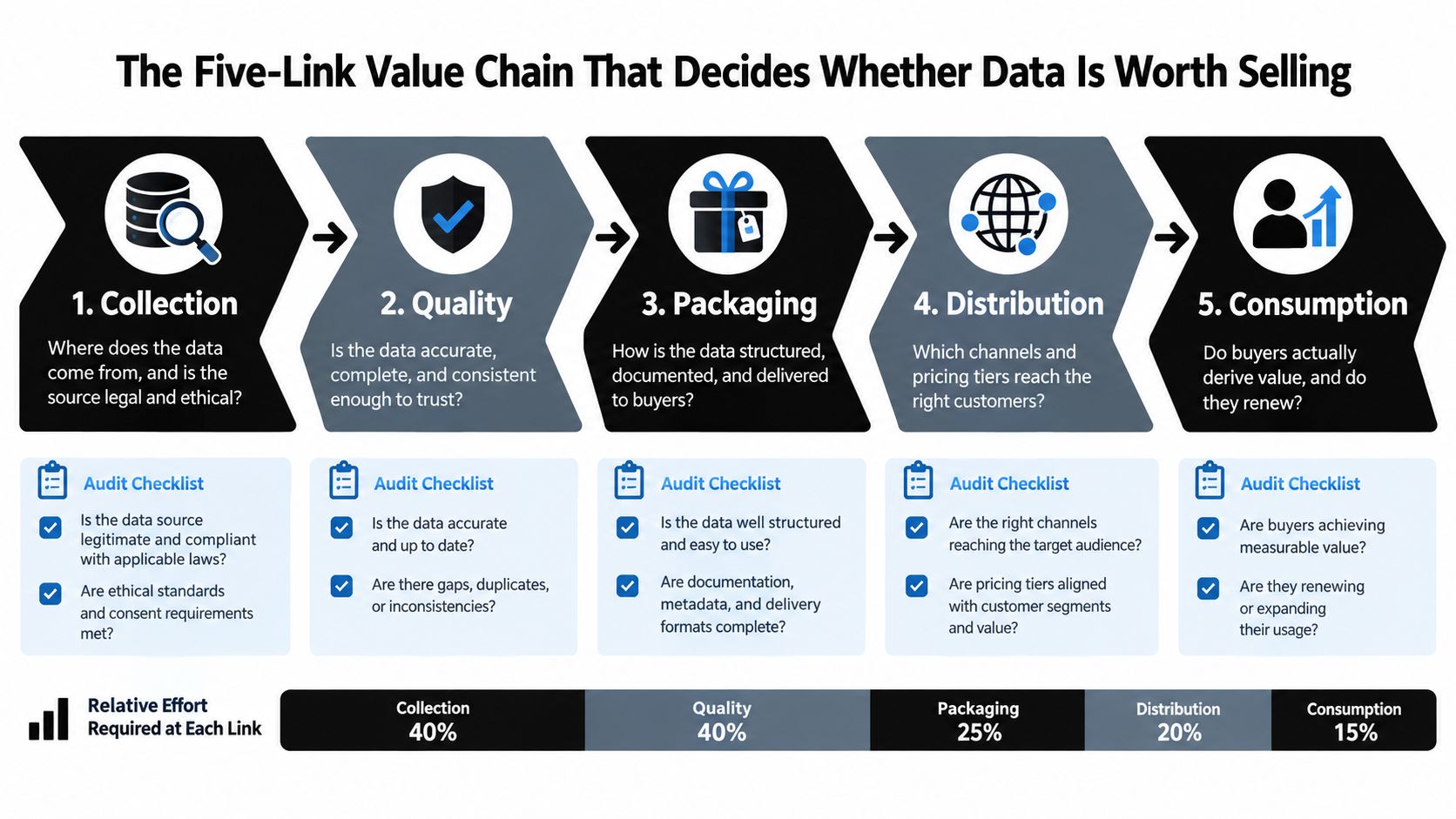
A dataset isn't a product until five links work together: collection, quality, packaging, distribution, and consumption. A weakness in any link can destroy the value created by the others.
Collection
Start with provenance. Where did each field come from? Did the user provide it directly, did your software derive it, or did another system import it? What did the user agree to, and what important context is missing?
A founder platform may collect profile data, search terms, messages, and matching outcomes. Those fields have different sensitivity and different commercial uses. Don't treat them as one undifferentiated asset.
Quality
Buyers need to know whether the information is current, complete, consistent, and biased toward a particular population. A small, accurate dataset can be more useful than a large, stale one, but only if the buyer understands its boundaries.
Create a lightweight quality scorecard:
- Freshness: When was each field last updated?
- Completeness: Which fields are commonly absent?
- Consistency: Do the same labels mean the same thing across records?
- Bias: Which users, industries, regions, or behaviors are overrepresented?
- Stability: Are definitions changing between releases?
Packaging
Packaging turns internal data into something another person can evaluate. Define the schema, field descriptions, aggregation rules, refresh process, lineage, access limits, and known exclusions.
For early validation, packaging can be a PDF brief, spreadsheet, dashboard, or static sample. Don't confuse a polished API with a useful product. A buyer who can't explain how the output enters their workflow won't be rescued by better documentation.
Distribution
The right channel depends on the model. A premium feature uses your existing product. A partner report uses a sales relationship. An API may need documentation, authentication, entitlement controls, and support. Distribution should follow the buyer, not the founder's preferred technology.
Market research can help identify who already pays for adjacent information and how they use it. A practical starting point is this guide to market research for a startup.
Consumption
Consumption is the final test. Does the buyer use the output in a recurring decision? Can they tell when it helped? Does the product fit their existing tools, or does it create another dashboard they must remember to open?
Score every link from weak to strong using evidence, not confidence. If consumption is weak, stop building and interview users. If quality is weak, narrow the promise. If packaging is weak, produce a sample. The score tells you which constraint deserves attention first.
A Six-Step Framework to Design and Implement Your Strategy
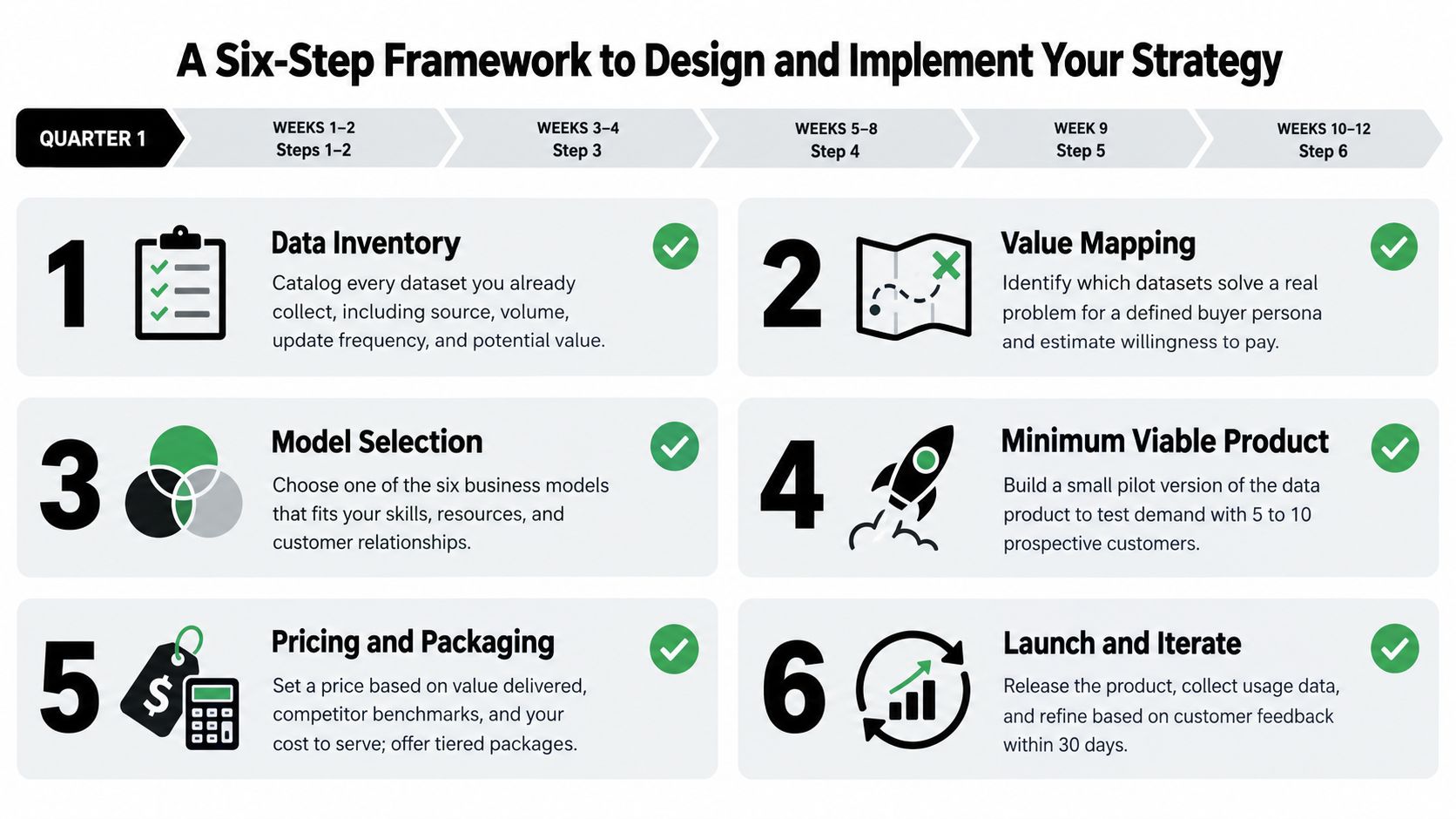
A solo founder can run a serious data monetization strategy without starting with a warehouse. The first objective is not scale. It's evidence.
Step 1, inventory what already exists
Create a plain spreadsheet with each dataset, source, owner, fields, update pattern, sensitivity, and current use. Include exports from support tools, CRM systems, analytics platforms, product databases, and manual research.
The output is a data inventory, not a technology roadmap. Kill the idea if you can't identify a legitimate source, a responsible owner, and a plausible buyer problem.
Step 2, map value to a specific buyer
List the decisions your potential customers make repeatedly. Then map each dataset to one decision and one buyer persona. A startup-program manager might need aggregated founder demand by skill category. A partner might need evidence about search friction. A product customer might need recommendations inside the existing workflow.
Rank candidate uses by customer value, access to buyers, privacy risk, and delivery effort. Finish with a short list and an explicit “do not build” list. If you have five exciting ideas, you probably haven't prioritized.
Step 3, select one model
Choose the least expensive model that can test the hypothesis. A report may validate willingness to pay before an API. An embedded feature may test value before a separate subscription. Internal optimization may be the right answer if it improves the core business more than an external offer would.
At this stage, write a one-page product specification covering audience, input data, output, decision supported, refresh expectation, delivery format, price hypothesis, and kill criterion.
Step 4, create a minimum viable product
The MVP should be small enough to deliver manually. A benchmark PDF, curated spreadsheet, private dashboard, or limited partner feed can reveal whether the customer cares. Don't build generalized infrastructure for a product that has no confirmed workflow.
Use this guide to build a minimum viable product with the same discipline you'd apply to a core startup feature.
Step 5, price the promise
Ask prospective customers what they currently spend in time, tools, labor, or missed opportunity to solve the problem. Then test a paid pilot with defined scope. Don't ask whether they “like the idea.” Ask whether they'll approve a purchase, introduce the budget owner, or sign a pilot agreement.
Step 6, launch with governance attached
The first release needs a data brief, terms of use, quality notes, support boundary, and deletion or correction process. Governance isn't a later enterprise feature. It determines whether a cautious buyer can say yes.
MIT CISR's 2024 survey of 349 executives found that top-performing organizations attributed 11% of revenue to data monetization, compared with 2% among bottom-performing organizations, a gap of more than five times. The research connects performance with capabilities such as governance, lineage, liquidity, AI capability, and organizational access to data. MIT CISR's data monetization research
The lesson isn't to copy enterprise architecture. It's to invest in reusable definitions once a paid use proves that investment is justified. Until then, keep the loop short, the output narrow, and the kill threshold visible.
How SourceX Can Help
Some founders aren't trying to create an insight product. They have valuable operational records and want to explore licensing them for AI training or evaluation without becoming a licensing department. That's where data monetization strategy resources from SourceX can help clarify the path.
SourceX licenses approved business data directly from companies. It acts as a licensing partner across assessment, rights review, preparation, delivery, and payout, with each transaction governed by an agreement defining scope, permitted uses, confidentiality, selection conditions, and payment terms.
Where the service fits
SourceX is relevant when the data has accumulated through real business operations and may capture decisions, support interactions, engineering work, sales activity, or other business experience that public datasets don't reproduce well. It can help with:
- Qualification: Assess licensing potential before requesting uploads.
- Inventory: Map records across systems such as Zendesk, Salesforce, GitHub, Jira, SharePoint, and Google Workspace.
- Rights and provenance: Document origin, permissions, prior commitments, and permitted uses.
- Preparation: Coordinate dataset-specific preparation and de-identification under agreed requirements.
- Commercial terms: Define scope, pricing, confidentiality, exclusivity where applicable, payment terms, and use restrictions.
- Delivery and payout: Manage approved delivery and company payments under the signed agreement.
The strongest differentiator is the managed relationship. Instead of separately finding a buyer, negotiating rights, coordinating processing, and tracking payment, the company works through one licensing counterparty. That doesn't eliminate the need for internal review. The company still needs to approve which records are licensed and confirm that the agreement matches its obligations.
When it's the right choice
SourceX makes sense when the data is business-generated, fragmented across systems, potentially useful to AI developers, and difficult to commercialize through your own sales channel. It's less suitable when your advantage comes from a proprietary insight that should remain inside your product, or when the data is too sensitive to share even after the agreed preparation process.
Compare the alternative. Building an in-house licensing operation gives you direct control, but it also leaves you responsible for qualification, provenance, rights, preparation, buyer discovery, contracting, delivery, and supplier payments. A managed partner can reduce operational load, but you'll need to assess agreement terms, selection criteria, downstream use, confidentiality, and economics before committing.
Pricing Models and Unit Economics for Data Products
Founders often copy enterprise pricing before they understand the buyer's budget or their own delivery cost. Early pricing should be simple enough to explain in one conversation and controlled enough that a heavy customer can't destroy the margin.
| Model |
Best for |
Margin profile |
Main risk |
| Flat subscription |
Stable access to a defined report or feature |
Predictable revenue, but support can expand quietly |
Underpricing intensive users |
| Usage-based |
APIs or processing with measurable consumption |
Can protect margin as usage grows |
Unpredictable bills and buyer resistance |
| Tiered |
Different buyer sizes or depth of insight |
Strong packaging leverage |
Confusing limits and upgrade friction |
| Freemium |
Product-led discovery and low-cost sampling |
Paid conversion can fund broad reach |
Free usage creates cost without learning |
A flat subscription works when the output is standardized and usage doesn't vary much. Usage-based pricing fits machine access, record processing, or high-volume queries. Tiering lets you separate basic visibility from deeper analysis, higher refresh frequency, or broader permissions. Freemium should be used as a learning mechanism, not as a default. If the free tier doesn't reveal activation or conversion evidence, remove it.
Model the economics before choosing the price
Separate fixed platform investment from variable delivery cost. Fixed costs can include data engineering, platform enablement, governance, documentation, and initial product work. Variable costs may include cloud compute, storage, refresh cycles, quality checks, support, privacy review, and incremental sales effort.
PwC identifies data engineering, platform enablement, and governance as typical fixed costs. Its CFO guidance also notes that delivery costs can fall below 20% of revenue when firms avoid bespoke builds and services-heavy delivery. PwC's CFO guidance on data monetization
Calculate contribution margin as:
Revenue minus cloud costs, storage, data-quality operations, support, privacy review, and incremental sales costs.
Then test the downside case. What happens if usage is higher than expected, refresh work takes longer, the buyer delays renewal, or one customer becomes too large a share of revenue? A base subscription with a usage cap is often the safest early structure. The subscription funds the platform, while defined overage or a higher tier captures heavy usage without giving the buyer an unlimited liability.
Governance should appear in the commercial package. Publish the data's provenance, freshness, known gaps, permitted use, access controls, and correction process. Buyers pay more confidently when they can audit the promise.
Legal, Ethical, and Governance Foundations That Earn Buyer Trust
Governance is not paperwork added after product-market fit. It's part of the product's sales argument. A buyer deciding whether to use your data is also deciding whether your permissions, quality controls, security practices, and incident response will create work for their legal and compliance teams.
A 2025 data-management survey reported that 69% of respondents saw security and compliance as a top obstacle to data initiatives, while 62% reported compliance failures linked to data-management difficulties. Those figures show why governance gaps block revenue rather than merely create administrative inconvenience. The data-management survey findings
Publish a minimum data contract
Attach a short contract or product brief to every pilot. It should identify:
- Ownership: Who owns the source data, derived outputs, and prepared product?
- Permitted use: What may the buyer do, and what uses are prohibited?
- Consent and notice: What permissions or disclosures support the intended use?
- Deletion rights: How can a person or customer request correction or deletion where applicable?
- Lineage: Which systems and transformations produced the output?
- Quality: What do freshness, completeness, known gaps, and validation mean?
- Security: Who can access the product, and how are entitlements managed?
- Incidents: What happens if the data is wrong, exposed, or used outside the agreement?
The safest product often contains aggregated or derived insight, not individual records. Separate personally identifiable information from consented aggregates, restrict access by purpose, and avoid offering row-level data because a buyer asks for it.
Two founders, two sequencing choices
Founder A monetizes too early. They export user-level records, promise a broad dataset, and negotiate a custom delivery before confirming rights or refresh effort. The first buyer's questions expose missing lineage, unclear deletion handling, and inconsistent fields. The founder spends time repairing trust instead of learning demand.
Founder B delays external sales long enough to document provenance and test an aggregate report. The first offer has a narrow audience, a defined use, and a correction process. That founder may launch later, but the product is easier to explain and safer to renew.
This is the same discipline as broader startup risk management for startups. Make the downside explicit before the upside becomes emotionally important.
Governance is a commercial feature: a narrow product with documented limits can beat a broad product that forces every buyer to investigate your entire data operation.
Never accept vague clauses that grant unrestricted resale, indefinite retention, undefined downstream AI training, unilateral changes to permitted use, or unlimited liability without matching control. A small company can't absorb obligations it can't monitor.
Startup Case Studies and Tactical Tips for Solo Founders
A solo founder launches a data marketplace during the second month of a startup. They build upload flows, buyer accounts, search, payments, and access controls. Months later, the marketplace has no repeat buyer because the founder never proved which decision the data would improve.
A different two-person team starts with a narrow benchmark report for a founder-matching market. They sell a recurring report, learn which questions partners ask, and use those conversations to shape a later machine-readable product. The important lesson is sequencing, not the particular format or price.
A 2025 PwC survey found that one-quarter of organizations had not started data monetization. The most common barriers included proving cost-effectiveness, gaining executive support, and generating viable use cases, which makes portfolio selection more important than premature infrastructure. PwC's 2025 data monetization survey
Tactics that work
- Test willingness to pay: Show a sample, name the decision it supports, and ask for a paid pilot or buyer introduction.
- Use a free tier carefully: Give away enough to prove relevance, not enough to eliminate the reason to upgrade.
- Write a one-page data brief: Include source, audience, fields, refresh, limitations, use rights, and the decision supported.
- Split ownership: One person owns data definitions and quality. Another owns product delivery and customer outcomes.
- Do this: Sell a repeatable output to a named buyer.
- Not that: Build a general marketplace for an undefined audience.
The fastest learning loop usually uses manual delivery first. If customers repeatedly request the same fields, format, cadence, and interpretation, you've found candidates for productization.
KPIs, a 30-Day Pilot Plan, and Common Questions
Measure the product's health, not its activity. Downloads and API calls can rise while customers fail to activate, renew, or recover the cost of delivery.
Track four indicators:
- Freshness: Whether the data arrives within the promised window.
- Activation: Whether a new customer uses the output in the intended workflow.
- Renewal: Whether customers continue because the product remains useful.
- Gross margin: Whether revenue remains after variable delivery and support costs.
A 30-day pilot
Days 1 to 7: Choose one buyer, one decision, one dataset, and one output. Interview potential users and write the kill criterion.
Days 8 to 14: Create a manual sample, document provenance, define permitted use, and test a price with real decision-makers.
Days 15 to 23: Deliver the pilot to a small group of paying or formally committed users. Record usage, questions, corrections, and support time.
Days 24 to 30: Compare customer value with delivery cost. Scale only if the buyer activates, the output is repeatable, governance holds, and the economics improve with standardization.
Questions founders avoid
When shouldn't you monetize? When the same data can produce more value by improving retention, product quality, or internal decisions, or when permissions and quality are unresolved.
What if a buyer demands raw records? Explain the decision the product supports and offer an aggregated or derived alternative. Don't weaken privacy controls to close one deal.
What if governance blocks a sale? Treat that blockage as product feedback. Narrow the scope, document lineage, clarify permitted use, and return with a safer offer.
A data monetization strategy isn't a one-time deliverable. It's a discipline for choosing the highest-value use of information, proving demand before infrastructure, and refusing revenue that creates unmanageable liability.
If you're building a founder platform, start this week by inventorying your existing signals, identifying one buyer decision, and testing one narrowly scoped paid insight. IndieMerger helps solo founders find verified complementary co-founders, so you can turn a promising data product into a focused team effort without starting with an oversized build.